Marketing Research
OpenAI's latest Signals data puts marketing material among the three biggest things people do for work in ChatGPT. The strategy behind it gets far fewer messages. Below are the numbers and their limits, and what we think they mean for teams that want AI to make marketing better, not just faster.

derrick-cramer
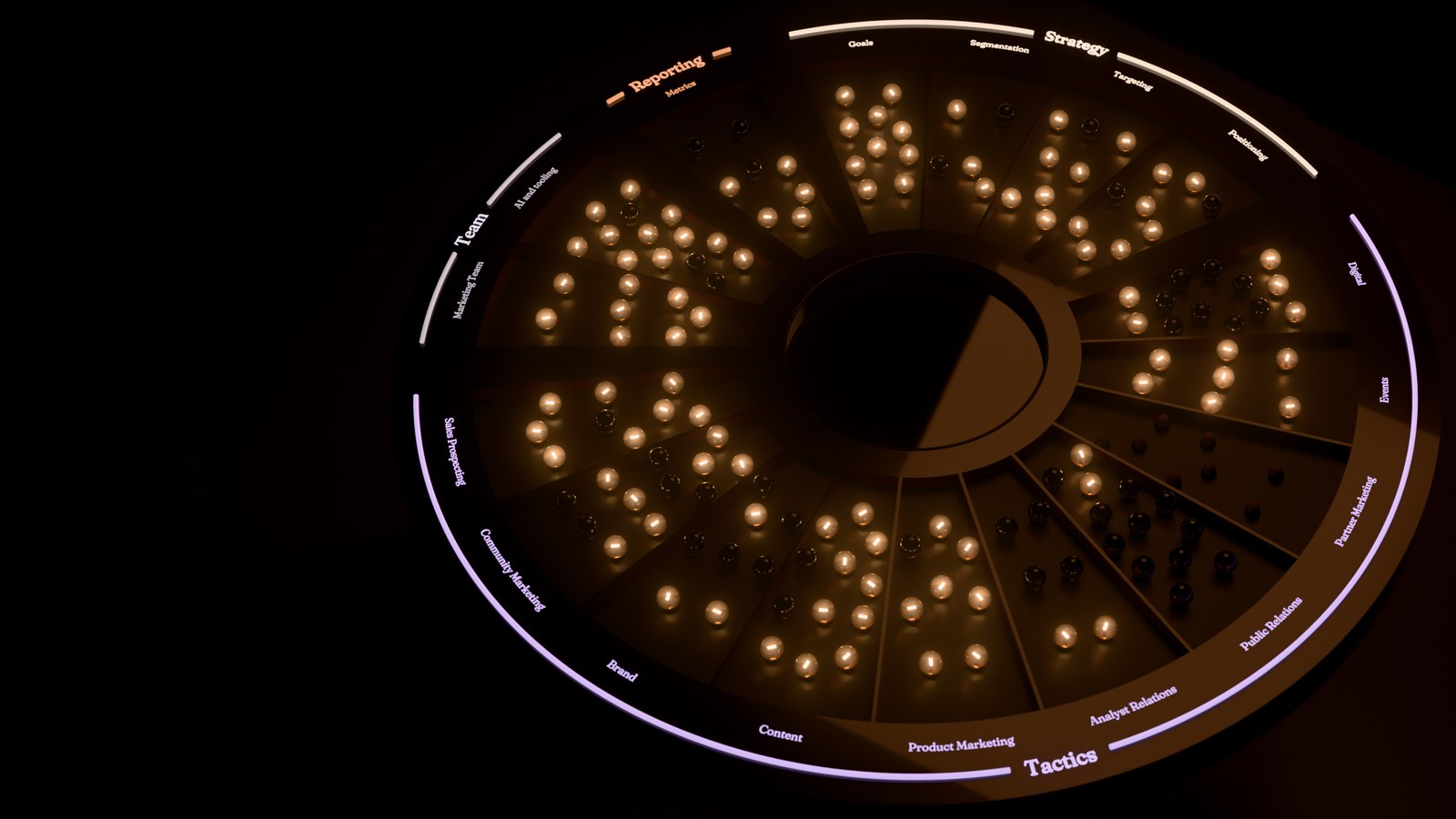
On personal ChatGPT accounts, marketing work is mostly production. About one work message in twenty asks for marketing or promotional material. The core strategy tasks get about a third as many messages as the core production tasks.
The data covers personal accounts only. ChatGPT Enterprise, Edu and Codex are excluded, so strategy work on company seats does not show up here.
Top 12 work activities, Q3 2026
Share of work-related messages, 74-country average. Marketing-type activities are in copper; visual designs include work that isn't marketing. Hover or tap a bar for the US figure.
Source: OpenAI Signals v3.0, CC BY 4.0. Analysis: Gossamer.
OpenAI has published version 3.0 of its Signals data, with its own write-up of how ChatGPT use at work is spreading. It is one of the largest public samples of what people ask an AI assistant to do. Each month OpenAI samples a million messages from adult users of its personal plans, leaving out deleted accounts and anyone who opted out of training. Models label the messages and researchers never see the text. The published shares carry added privacy noise.
The most useful table for marketers sorts work messages into O*NET work activities, the US Department of Labor's catalogue of what jobs involve. It covers 164 activities in 94 countries, quarterly from Q1 2025 to Q3 2026.
We picked out the activities that describe marketing work and grouped them by stage: understanding the market, deciding the strategy, making the material and selling. Then we compared them across 74 countries and seven quarters. The charts below switch between the 74-country average and the US, and the country table sorts.
A caution before the numbers. The data describes tasks and has no job-title field, so the marketing work here could come from marketers, founders, freelancers or students. It also leaves out company accounts entirely. We come back to both points below.
Share of work messages by stage
Quarterly, Q1 2025 to Q3 2026. Creative production includes work that isn't marketing. The switch also changes the next two charts and the activity table.
Source: OpenAI Signals v3.0, CC BY 4.0. Analysis: Gossamer.
The production-to-strategy gap under four definitions
Making divided by strategy, Q3 2026. Core making is marketing materials and commercial writing; all making adds visuals, content and audio or video. Broad strategy adds eight business-strategy tasks to the seven marketing ones.
Source: OpenAI Signals v3.0, CC BY 4.0. Analysis: Gossamer.
Inside production: visuals take off
Share of work messages, quarterly. Visual designs more than doubled while marketing materials held flat and commercial writing slipped.
Source: OpenAI Signals v3.0, CC BY 4.0. Analysis: Gossamer.
25 marketing and business-strategy activities
Share of work messages, Q1 2025 and Q3 2026, on the basis selected above. Changes in activities below 0.5% are noisy.
Source: OpenAI Signals v3.0, CC BY 4.0. Analysis: Gossamer.
What work messages are about
Topic of work-related messages, monthly, global, July 2024 to September 2026.
Source: OpenAI Signals v3.0, CC BY 4.0. Analysis: Gossamer.
Each dot is a country
Share of work messages, average of Q4 2025 to Q3 2026, on the same scale for both rows. The Netherlands is in copper; hover or tap a dot for its values.
Source: OpenAI Signals v3.0, CC BY 4.0. Analysis: Gossamer.
All 74 countries
Share of work messages, average of Q4 2025 to Q3 2026. Tap a heading to sort.
Source: OpenAI Signals v3.0, CC BY 4.0. Analysis: Gossamer.
Making marketing material cheaper is a real gain. A client of ours spent about eight hours learning to make eBooks, flyers and print-ready PDFs in-house with Claude. That saved roughly €10,000 set aside for a freelancer. It also helped redirect six figures of budget earmarked for outside help toward building the capability in-house.
The question this data raises is what all that production is aimed at. Every flyer, deck and landing page rests on decisions made upstream. Which accounts do we go after, what do we tell them, what do we charge and what do we stop? On personal ChatGPT accounts, those decisions get about one message for every three spent producing the material.
Much of this usage comes from small businesses and freelancers, so it covers a wider market than B2B SaaS. Our own research points the same way for B2B teams, though. In October we analysed 466 B2B marketing job ads. 163 of them asked for at least one capability in goals, segmentation or targeting. Even so, those three areas made up only 5% of all the capabilities mentioned. ICP definition came up in 11 ads and market segmentation in 3.
Hiring and AI use both lean away from goals, segmentation and targeting. That matters because AI accelerates whatever system it lands in. In a team chasing this quarter's pipeline, cheaper output brings more of the same campaigns, sooner.
The same tools make it almost free to try work a team never had the time or skills for. A proper segmentation and a pricing test are good places to start. That is the better route. The rise in pricing work hints that some people are taking it, though a few quarters of noisy data is thin evidence.
If you lead a marketing team, three questions are worth asking of your own AI use:
Company seats may hold more strategy work than this data can see. Treat it as a prompt to look at your own team's AI use, and at which side of that three-to-one ratio it falls.
Data. Aaron Chatterji, Thomas Cunningham, David J. Deming, Zoe Hitzig, Drew Johnston, Alex Martin Richmond, Christopher Ong, Carl Yan Shan and Kevin Wadman, OpenAI Signals v3.0, OpenAI, 2026, downloaded 26 October 2026. Licensed under Creative Commons Attribution 4.0.
Method. Aaron Chatterji, Thomas Cunningham, David J. Deming, Zoe Hitzig, Christopher Ong, Carl Yan Shan and Kevin Wadman, “How People Use ChatGPT”, NBER Working Paper 34255, 2025, doi:10.3386/w34255.
Changes made. Gossamer selected 25 of the O*NET work activities and grouped them into stages. We averaged them across the 74 countries reported in every quarter, and over the last four quarters for the country comparison. We calculated the ratios and changes shown. OpenAI has not reviewed or endorsed this analysis.
Curious where these patterns show up in your own marketing? The Gossamer Audit scores 17 categories, traces every score to evidence and hands back one prioritised roadmap.